Living with a baby in a small apartment can feel overwhelming before the baby even arrives. Parents see long registry lists, oversized nursery setups, large swings, multiple strollers, storage towers, changing stations, and baby gadgets that all promise to make life easier. But in a small home, every item has to earn its space. A minimalist baby setup is not about depriving the baby or buying nothing. It is about choosing fewer, better, safer, and more useful products that fit the way the family actually lives.
For apartment parents, especially those living in cities like Brooklyn, Queens, Manhattan, Jersey City, Hoboken, or other dense urban areas, space is part of every decision. A crib may sit in the parents’ bedroom. A stroller may need to fold near the door. Feeding supplies may share a tiny kitchen counter. Bath items may need to dry quickly and store flat. The goal is to create a calm, functional baby environment without letting baby gear take over the home. Parents can begin by focusing on safe baby products that support real daily routines instead of buying every product that appears on a standard registry list.
Minimalism Starts With Safety, Not Style
Minimalist baby shopping is often presented as a design choice, but for parents, it should start with safety. A clean, uncluttered nursery or sleep corner can also support safer habits. For example, babies do not need pillows, loose blankets, stuffed animals, bumpers, or decorative cushions in their sleep space. The American Academy of Pediatrics recommends that babies sleep on their backs on a firm, flat surface without soft objects or loose bedding. Parents can review the AAP’s official safe sleep guidance for more details.
This is good news for small apartment families because safe sleep does not require a large nursery. A firm crib mattress, a fitted sheet, and a properly assembled crib, bassinet, or play yard may be enough. Minimalism helps parents avoid filling the sleep area with items that look cute but do not belong there. A simple, clear sleep space is easier to maintain, easier to clean, and easier to inspect. Families setting up a compact sleep area can explore sleep and nursery ideas that focus on practical safety rather than oversized decoration.
Choose One Safe Sleep Space
Many parents feel pressure to buy multiple sleep products: a crib, bassinet, portable sleeper, travel crib, lounger, swing, and nap station. In a small apartment, this can quickly create clutter and confusion. A minimalist approach begins by choosing one primary safe sleep space that fits the home. For some families, that may be a compact crib. For others, it may be a bassinet for the early months followed by a crib or play yard later. The key is that the product must be designed for infant sleep and used according to instructions.
Parents should avoid using loungers, swings, nursing pillows, soft cushions, or inclined products as sleep spaces. These items may be marketed as convenient, but convenience should never replace safe sleep rules. In a small apartment, it is especially important not to keep too many “almost sleep” products around because they can encourage unsafe habits during tired moments. A minimal sleep setup reduces decision fatigue. When the baby is sleepy, parents know exactly where the baby belongs.
Pick a Stroller That Matches Apartment Life
A stroller is often one of the biggest baby purchases, and in a small apartment it can become one of the biggest storage challenges. Minimalist parents should choose one stroller that fits their real lifestyle instead of buying several. The right stroller for a walk-up apartment may be different from the right stroller for a building with an elevator. Parents who use public transit may prioritize weight and foldability. Parents who walk long distances may care more about wheels, suspension, storage, and weather protection.
Before buying, parents should measure the entryway, hallway, closet, and elevator if relevant. They should test whether the stroller folds easily and whether it can stand or hang in a small storage area. A stroller that looks beautiful but blocks the front door every day will quickly become frustrating. Minimalism is not about buying the smallest stroller available. It is about buying the stroller that solves the most daily problems with the least space and effort.
Use a Baby Carrier to Reduce Gear Dependence
A baby carrier can be one of the most useful minimalist products for apartment parents. It can help with short errands, stairs, soothing, laundry, and moving through tight spaces where a stroller is inconvenient. A carrier can also reduce the need for extra seats or bulky soothing gear because the baby can stay close while the parent moves around. However, parents should choose a carrier that is comfortable, age-appropriate, adjustable, and used correctly.
Parents should always follow the carrier manufacturer’s instructions and keep the baby’s airway clear. A carrier that works for one parent may not work for another, so fit matters. A soft wrap may feel better during the newborn stage, while a structured carrier may feel more supportive later. In a small apartment, the best carrier is one that stores easily, washes reasonably well, and gets used often. If it is too complicated, it may become clutter.
Keep Feeding Gear Simple
Feeding products can take over a small kitchen quickly. Bottles, nipples, drying racks, sterilizers, warmers, formula containers, bibs, burp cloths, plates, spoons, cups, and high chairs can fill every counter and drawer. A minimalist feeding setup should focus on what the baby actually needs now, not what might be useful months later. Parents can start with a small number of bottles, a bottle brush, a compact drying rack, a few burp cloths, and feeding items that match whether the baby is breastfed, formula-fed, combination-fed, or starting solids.
When the baby grows, a compact high chair or clip-on style seat may be useful, depending on the apartment layout and table type. The best feeding gear is easy to clean, stable, and simple to store. Parents should avoid buying too many bowls, plates, and specialty tools before knowing what the baby will actually use. Families can use feeding gear guidance to build a setup that supports daily meals without overcrowding the kitchen. In small apartments, the easiest product to clean is often the one parents appreciate most.
Choose Multi-Use Items Carefully
Multi-use baby products can be helpful in small apartments, but only when they truly work well in more than one role. A play yard with a bassinet insert may support sleep and travel needs if it meets current safety guidelines and fits the home. A dresser can double as a changing surface when paired with a secure changing pad and safe supervision. A diaper caddy can move from room to room instead of requiring a full changing table. A storage ottoman can hold baby blankets, carriers, or toys while also serving the living room.
However, parents should be careful with products that claim to do everything but do nothing well. A bulky all-in-one station may take up more space than separate simple items. A product that transforms in many ways may be harder to clean, assemble, or store. Minimalism works best when multi-use items are genuinely practical, not just clever in marketing photos. Parents should ask: will we use each function, or are we paying for features that will stay folded, hidden, or forgotten?
Skip the Oversized Changing Table
A dedicated changing table can be nice, but many apartment families do not need one. Diaper changes can happen safely on a changing pad placed on a dresser, a bed, or a clean floor surface, as long as the baby is supervised and supplies are within reach. A small diaper caddy with diapers, wipes, cream, hand sanitizer, and a change of clothes can be more flexible than a large changing station. This is especially useful when the apartment has only one bedroom or when parents move between rooms during the day.
Minimalist diapering also means not overstocking sizes too early. Babies grow quickly, and some brands fit differently. Parents can keep a practical supply without filling closets with months of diapers that may not fit later. Wipes, diaper cream, and liners should be stored where they are easy to reach but not spread across every surface. A simple diaper routine saves space and reduces the feeling that baby care has taken over the entire apartment.
Make Bath Time Compact
Baby bath products should be simple, gentle, and easy to store. A foldable baby bathtub, soft washcloths, hooded towel, gentle cleanser, and a small moisturizer may be enough for many families. Parents do not need a shelf full of scented washes, oils, lotions, and specialty bath items. In fact, babies with sensitive skin often do better with fewer products. The U.S. Food and Drug Administration provides general information about soaps, lotions, and cosmetics, which can help parents understand why ingredient awareness matters.
Small bathrooms need products that dry quickly and store easily. A bathtub that hangs on the shower wall or folds into a closet may be more practical than a bulky tub that sits in the way. Parents should also avoid keeping too many bath toys early on. Bath time for a young baby is mostly about safety, warmth, support, and gentle cleaning. Families can review bath and body care ideas for simple routines that do not crowd the bathroom.
Limit Toys and Rotate Them
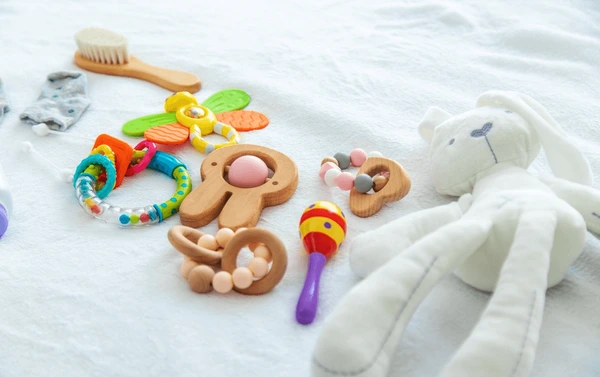
Baby toys can multiply quickly, especially when friends and relatives are excited to give gifts. But babies do not need a huge toy collection. A few safe, age-appropriate items are usually enough at one time. Soft books, rattles, teethers, textured toys, and simple play mats can support early development without filling every corner. The American Academy of Pediatrics has also emphasized the value of simple toys and parent interaction in young children’s development through guidance on choosing appropriate toys, including its report on selecting appropriate toys for young children.
In small apartments, toy rotation is more useful than toy accumulation. Parents can keep a few items accessible and store the rest in a small bin. Rotating toys every week or two can make old toys feel new again without buying more. Minimalist toy storage also helps keep the floor clear, which matters once the baby starts rolling, crawling, and pulling up. Less clutter can make the home safer and calmer for everyone.
Use Vertical and Hidden Storage
Minimalist baby living is not only about buying less. It is also about storing better. Small apartments benefit from vertical shelves, under-crib storage, hanging organizers, door hooks, drawer dividers, and baskets that fit existing furniture. Parents should avoid turning every surface into open baby storage. When supplies have a defined home, the apartment feels less chaotic.
A simple system may include one diaper caddy, one feeding drawer, one clothing drawer, one bath bin, and one toy basket. If something does not fit into the system, parents can ask whether it is truly needed. Baby items should be easy to access but not scattered everywhere. Minimalism works best when parents can find what they need quickly, especially during late-night changes or early morning feedings.
Reduce Home Toxins Without Buying Everything New
Small apartments can also benefit from a minimalist approach to home toxin reduction. Parents do not need to replace every item in the home at once. They can start with habits that reduce avoidable exposure: remove shoes at the door, wet-clean dust, choose fragrance-free cleaning products, wash baby textiles before use, avoid unnecessary sprays, and keep the sleep space simple. These small choices can make the home feel cleaner without filling cabinets with specialty products.
Families who want to think more carefully about indoor environments can explore home toxin reduction guidance. In small spaces, strong fragrances, clutter, dust, and excess products can feel more concentrated. A minimalist home often becomes easier to clean because there are fewer surfaces, bins, and unused items collecting dust. That practical cleanliness can be just as valuable as buying special products.
Buy Slowly When Possible
One of the best minimalist baby strategies is buying slowly. Parents often feel pressure to have everything before the baby arrives, but many products are easier to choose after the family understands the baby’s habits. Some babies love carriers. Some do not. Some families use a stroller every day. Others rely more on short walks and babywearing. Some feeding items become essential; others stay unused. Buying slowly allows parents to avoid filling a small apartment with products that may not fit their routine.
A basic newborn setup can be simple: safe sleep space, diapers, wipes, a few clothes, feeding supplies, bath basics, a car seat if needed, and a way to carry or transport the baby. Other items can be added as real needs appear. Minimalism gives parents permission to wait. It also helps protect the budget, reduce returns, and keep the apartment more peaceful.
The Bottom Line for Small Apartment Parents
Minimalist baby products are not about having less for the sake of having less. They are about choosing what truly supports safety, care, comfort, and daily function. In a small apartment, the best baby products are usually compact, easy to clean, easy to store, and useful across many real-life situations. Parents should prioritize safe sleep, simple feeding, compact bathing, flexible diapering, practical transport, and a calm home environment.
The baby does not need a perfect nursery or a long list of gadgets. The baby needs safe places to sleep, eat, be changed, be cleaned, be carried, and be loved. Parents need products that make those tasks easier instead of creating more clutter. A thoughtful minimalist setup can help a small apartment feel more organized, more breathable, and more ready for family life.